Black is the one nail color that operates outside trend cycles. It was relevant in the 1990s when dark nails read as subcultural, relevant in the 2000s when it became mainstream, relevant in the 2010s when minimalism made it the default sophisticated choice, and relevant now when the nail world is running through every possible interpretation of a surface that absorbs light rather than reflecting it. Celebrity manicurist Mazz Hanna put it plainly: black is "the little black dress of nail polish — it always works, it always fits, and it always makes you look like you meant it."
What makes black interesting as a nail base is that it creates a different set of design possibilities than any other color. On a light base, dark designs are visible. On black, only the lightest elements — white, gold, silver, neon, chrome — have enough contrast to read clearly. This constraint is also a creative filter: it eliminates entire categories of design and forces the work that remains to be particularly intentional. The 20 designs below make use of that constraint across finishes, techniques, and art styles — from the most reductive (pure matte black, nothing else) to the most layered (five different black designs on one hand).
Pure Black — The Finish as the Design
The most fundamental design decision in a black manicure is the finish. Matte black and glossy black are two entirely different materials: one absorbs everything including the shape of the nail, the other reveals the nail's form through reflection. Chrome is a third material entirely. These differences are the first choice, before any art enters the conversation.
1. Pure Matte Black — The Void

Completely flat matte finish with zero shine — the surface absorbs all light rather than redirecting any of it. The nail's shape is only visible through the shadow it creates against surrounding skin, not through any reflection from the polish itself. This is black at its most absolute: no variation, no dimension, no information given back to the eye except the color's presence and the nail's silhouette. On deep warm dark skin against black slate with single directional side lighting, the matte black nails almost disappear into their surroundings — visible as a form but barely distinguishable from the slate surface itself. The design requires nothing because the finish is already saying everything there is to say: this is what the complete absorption of light looks like on a fingernail.
2. Black Chrome Mirror — Maximum Contrast

Chrome powder applied over black gel base creates a surface that is the categorical opposite of matte black: where matte absorbs everything, chrome mirror redirects everything. The nail becomes a dark mirror — reflecting its surroundings in a black-toned version, capturing the overhead spotlight as a bright moving point that travels across each nail as the hand tilts. The reflection quality of black chrome is different from silver or gold chrome: it reflects at a darker, cooler temperature, which gives the surrounding reflection a dramatic, cinematic quality rather than a warm glamorous one. On dark espresso skin against a glass surface that provides a secondary reflection below, the whole composition reads as multiple dark mirrors layered over each other. Black chrome is particularly striking as a contrast to the matte version — same color, completely different relationship with light.
3. Black to Forest Green Ombré — Tonal and Moody

Black at the cuticle transitioning smoothly to deep forest green at the free edge — both colors so dark that the gradient is only visible in good light and up close. In dim or distant viewing the nails appear simply dark; the color shift reveals itself on closer inspection. The matte finish on both colors means the transition has no reflective variation to help mark its progress — the ombre is pure value and hue shift with no surface quality change to assist it. This is the most subtle design in the collection, building on the understanding that black and very dark green occupy similar tonal territory. On warm olive skin against dark green velvet, the nails and the surface are in dialogue — the velvet picks up the green of the tips while the black of the base reads against it.
Black With Line Work and Geometry
Thin lines on black require specific materials: the lines need to be either metallic (gold, silver) or very light (white) to have enough contrast against the black ground to read at nail scale. The designs below use line work in different structural approaches — from a simple cross to a complete Art Deco surface pattern.
4. Black With Fine Gold Line Geometric — Four Quadrants

Flat black gloss base divided by two gold lines 0.3mm wide: one vertical from cuticle to free edge, one horizontal across mid-nail. The two lines cross at the nail's geometric center, marked by a single 2mm clear AB crystal. The four quadrants of black base created by the cross remain untouched. The design works through proportion: two lines and one stone, nothing more, and the visual weight is precisely calibrated — the gold lines thin enough not to overwhelm the black base, the crystal large enough to mark the intersection as a deliberate focal point rather than a technical joint. On warm medium tan skin against dark wood in warm studio light, the gold on black reads as genuine precious metal against a dark material — the same visual relationship as gold inlay in black lacquer furniture.
5. Black With Gold Art Deco Geometric Web

Where the four-quadrant design uses two lines, the Art Deco web covers the entire nail surface. On flat black matte, a grid of thin gold lines 0.3mm creates repeating diamond shapes across the full nail — two sets of parallel lines crossing at 60-degree angles to form elongated diamond cells 5mm long. At each diamond intersection a 0.8mm gold bead marks the node. The pattern reaches all four nail edges. The effect is the full decorative program of Art Deco applied to nail scale: the formal geometry, the gold-on-dark ground, the repeated interlocking shapes. Matte rather than gloss is the right base finish for this design — the flatness of the matte surface makes the gold lines appear to sit on top of the surface with maximum clarity, rather than competing with gloss reflections.
6. Black With White Abstract Brushstroke

One bold white brushstroke per nail, 3-4mm wide, painted diagonally from the lower-left corner to the upper-right, with visible bristle texture and slightly rough irregular edges. The stroke is the entire art. Black gloss base makes the white appear brighter and more opaque than it would on any other ground — the contrast between jet black and bright white is the maximum possible in nail art. The brushstroke reference is deliberate: this design draws from abstract expressionism, specifically the tradition of a single mark that carries meaning through its quality rather than its subject. The irregularity of the stroke's edges and the visibility of the brush's bristle marks read as evidence of a hand making a decision — which is exactly what separates this from a painted stripe.
7. Black With White Geometric Color-Block Stripe

Four nails in flat matte black, no decoration. On the ring finger nail: three horizontal bands of color each 3mm wide, separated by 0.4mm black lines — deep cobalt blue at the cuticle, electric crimson in the middle, bright white at the free edge. The three color bands create a graphic accent nail that reads as a flag or signal within the monochrome black set. The four plain black nails exist specifically to isolate the one patterned nail, amplifying its visual impact through contrast with the surrounding uniformity. The three colors on the accent nail — cobalt, crimson, white — are each fully saturated, and against both the black nails around it and each other, they read at maximum intensity.
Black With Surface Art and Motifs
Black is the base that makes the most extreme contrasts possible. White, gold, silver, and neon all read with maximum clarity against it — which is why botanical illustration, foil work, and star scatter on black produce results that couldn't be achieved on any other ground.
8. Black With Scattered Silver Micro Stars

Glossy black base with approximately twelve four-pointed sparkle stars in metallic silver per nail, ranging from 1mm to 2.5mm, distributed asymmetrically with higher density near the cuticle and thinning toward the free edge. The four-pointed sparkle shape — two longer vertical points and two shorter horizontal ones — is the traditional way of representing a star's light in illustration rather than its astronomical form. In pinpoint studio lighting, each silver star catches its own small reflection of the light source, creating a constellation of twelve separate sparkle points per nail. On warm medium olive skin the metallic silver against black gloss reads as a night sky seen with unusual clarity — the kind of sky that urban light pollution usually makes unavailable.
9. Black With Silver Foil Crinkle Texture

Matte black base with crinkled silver foil applied in organic irregular patches covering 50-60% of each nail. The foil is not flat: it's crinkled, with folded ridges and compressed areas, so the metallic surface catches light at dozens of different angles within each patch. In raking studio light from the side, the foil texture creates a three-dimensional landscape of silver light against flat black matte — the contrast between the light-absorbing matte and the light-redirecting foil is at its most extreme in directional light. The patches are organic rather than geometric — no two nails have the same foil arrangement, and the ragged edges of the foil read as genuinely material rather than printed. This is black nail art that works through material opposition rather than drawn design.
10. Black With White Sakura Blossom

Black gloss base on all five nails. On two accent nails a Japanese sakura branch painted in grey-white: a thin branch 0.5mm wide entering from the lower corner and curving upward, with five-petal cherry blossom flowers 4mm in diameter at four branch points, petals teardrop-shaped and slightly overlapping, pale pink dots at each flower center. Loose single petals drift toward the free edge. Three nails remain solid black. The sakura motif on black is a specific cultural reference: in Japanese aesthetics, cherry blossoms are understood against dark backgrounds as symbols of transience — the brief brightness of the flower against the permanence of the dark. At nail scale the botanical illustration carries that reference compactly, and the restraint of only two decorated nails out of five keeps the design considered rather than busy.
11. Black With White Lace Overlay

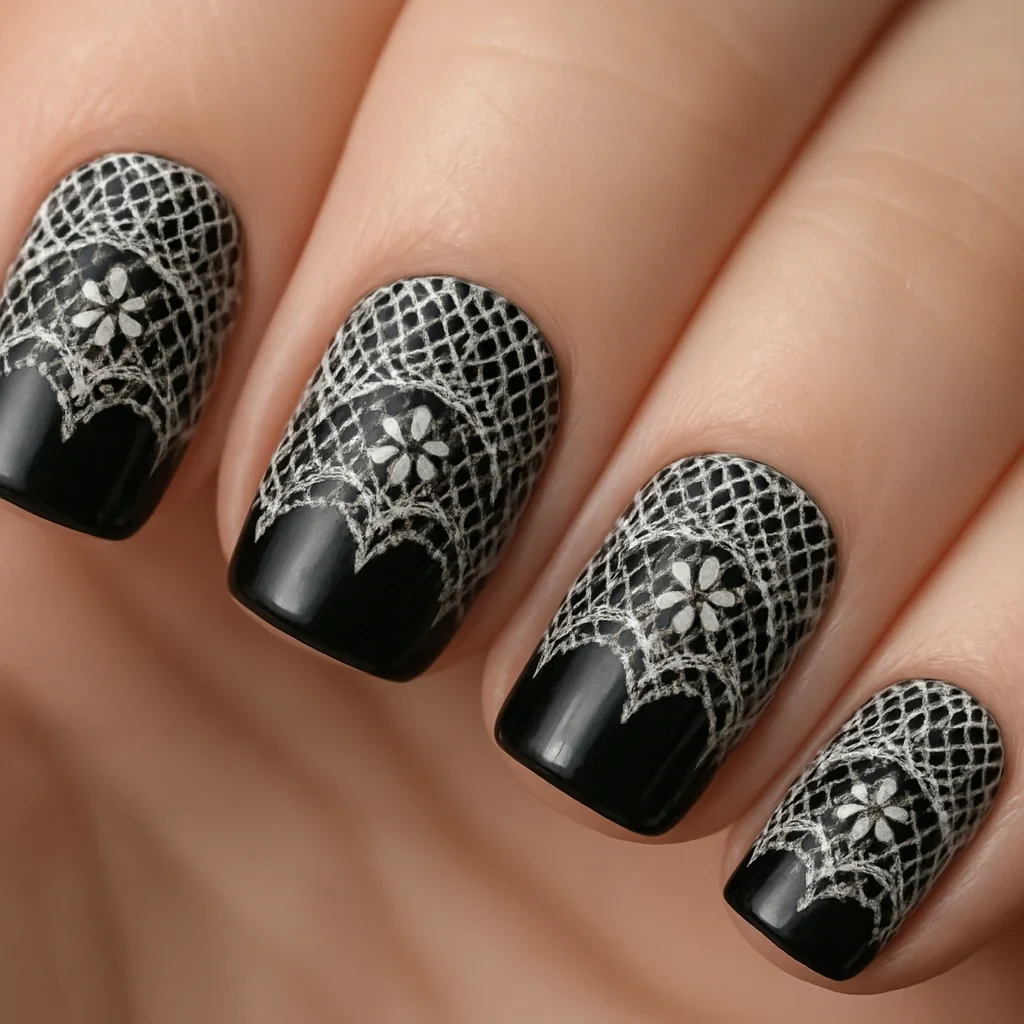
Black glossy base with a white lace pattern painted across the upper 60% of each nail: repeated arch motifs 3mm wide with connecting 0.3mm mesh lines, within each arch a small six-petal flower 1.5mm in diameter. The white is semi-opaque, so the black shows faintly through the lace layer — it reads as black lace rather than white lace on black, which is a meaningful distinction. Black lace has a specific cultural reference: Victorian mourning jewelry, Gothic fashion, dark romanticism. The design references that history without committing fully to any particular subculture, which is what nail art does best — borrowing the visual language of other traditions and wearing them as surface.
12. Black With Neon Drips

Black gloss base with three thin vertical drips running from the cuticle edge downward toward the free edge: one hot pink, one neon green, one electric yellow. Each drip starts 2mm wide at the cuticle and narrows to a teardrop point 5-7mm below, the three drips evenly spaced across the cuticle width. Black is the only base on which neon colors achieve their full luminous quality — on lighter bases neon appears bright; on black it appears to emit light. The drip format references graffiti aesthetics, acid house visual culture, and Y2K maximalism simultaneously without committing to any one of them. The teardrop terminal point of each drip is the design's most important detail: without it the drips would read as incomplete stripes rather than drops of neon pigment running under gravity.
13. Black With Red Negative Space Heart

Black gloss base on each nail with one absence: a heart-shaped section 5mm wide where the black is not, revealing red beneath — either a red base coat or the natural nail with red gel underneath. The heart has clean sharp edges; the black surrounds it completely on all sides. The red glows within the black frame in a way that red on a light base never quite achieves — black removes all competition and makes the red appear to generate its own light. The negative space technique is important here: the heart is not painted on the black but created within it, which gives it a different quality than a painted heart on black would. The heart shape is old and universally understood, which means the design communicates immediately regardless of context or cultural background.
14. Black With Rose Gold Holographic Chrome Tips

Black gloss base with a 5mm chrome tip at the free edge in rose-gold holographic powder — the tip shifting from pink to warm gold to green depending on the angle. The chrome is at maximum reflectivity at the very tip edge and fades very slightly over 1mm before meeting the black base at a crisp demarcation line. The design is a French manicure format with its values inverted: instead of a light tip on a nude base, a holographic tip on the darkest possible base. The rose-gold holographic against black creates a warm, glamorous contrast — the holographic shifts amplify each other against the non-reflective black ground. Nail publications including Hello Magazine noted that "colored chrome tips" on dark bases are among the most requested salon designs of 2026.
15. Black With Inverted White Marble Veins

Black gloss base with white veining painted as if marble were color-inverted: where standard marble has dark veins on a light base, this version has light veins on a dark base — the visual logic of black onyx or dark obsidian rather than Carrara marble. The main diagonal vein runs from the lower-right to the upper-left, 1.5mm wide with soft blurred edges. Three thinner sub-veins branch at 60-degree angles. Between the veins faint grey-white watercolor washes suggest the mineral translucency that makes actual dark stone appear to have depth. The inversion of the marble formula produces a result that is simultaneously recognizable as marble and completely unlike the white marble nail art that's been dominant in recent seasons — darker, more geological, more material.
Embellished and Three-Dimensional Black
The designs below add physical dimension to the black surface — stones that sit above it, raised sculptural elements that create real shadows. Three-dimensional work on black is particularly effective because the black base makes shadows more visible, which is what gives sculptural nail art its sense of depth.
16. Black With Full Crystal Encrusted Accent Nail

Four nails in glossy black, completely bare. On the ring finger nail, clear AB rhinestones cover every millimeter of the surface — packed in concentric rows from 0.5mm to 1.5mm stones with no gaps, the total surface reading as a solid mass of crystalline facets. The contrast between the four light-absorbing black nails and the one completely light-redirecting crystal nail is among the most extreme visual contrasts available in nail art. In directional amber lighting, the crystal nail catches the light as hundreds of small warm points while the four black nails hold completely still. The design works on the same logic as a single statement jewel in a plain setting: the plainness of everything else is the setting, and the stone — here, the entire nail — is the gem.
17. Black With 3D Sculptured Black Rose

A sculptured gel rose built entirely in black on a black gloss base — the most demanding design in this collection and the most conceptually specific. Five-layer petal construction: outermost petals 6mm wide with slight upward curl at the tips, inner petals progressively smaller spiraling to a tight center bud. The rose is entirely black: the same color as the base beneath it. The only visual information is the shadow the rose casts on the black base — the shadow reveals the flower's three-dimensional form against the flat black ground. In strong directional light the shadow reads clearly and the rose appears as a genuine sculptural object. In flat light the design becomes nearly invisible — which is, in its way, a final design statement about what black can do: it can conceal itself entirely while remaining fully present.
18. Black French Tips on Nude Base

The French manicure format inverted by color: sheer warm nude-beige base with a 4mm arc of glossy jet black at the free edge, crisp inner edge following the smile line. Where the classic French manicure places the lightest possible color at the tip, this version places the darkest. The result reads as a bold graphic statement using the most familiar nail format as its structure — the recognizability of the French manicure shape makes the black color feel even more deliberate, because the viewer understands they're looking at a version of something familiar made strange. Celebrity manicurists consistently cite "black French tips" as one of the most requested salon designs of 2026, noting that the format allows clients to wear black nails without the full commitment of an all-black manicure.
19. Black Velvet Cat-Eye — The Directional Stripe

Deep matte-velvet black base with a magnetic cat-eye stripe running diagonally at 40 degrees from lower-left to upper-right across each nail — a bright silver-gunmetal shimmer band 3mm wide with soft blurred edges that fade into the velvet base on both sides. The stripe is applied using a magnet held at the precise angle while the gel is wet, aligning iron particles in the formula to create the concentrated shimmer band. In certain light the stripe shifts to teal. The velvet matte base is specifically the right finish for cat-eye on black — the matte surface makes the shimmer stripe read with maximum contrast, while a gloss base would compete with the stripe's reflectivity. In blue-tinted moody side lighting, the silver stripe against velvet black reads as electric and precise — the kind of design that justifies the technical complexity of magnetic gel.
20. Maximalist Black Collage — Five Formats on One Hand

Five nails, five completely different black designs, united only by black as the primary base: chrome mirror on the thumb, matte black with gold Art Deco diamond grid on the index, black gloss with full edge-to-edge crystal encrustation on the middle, black velvet with silver cat-eye stripe on the ring finger, black gloss with a single large opaque white five-pointed star 7mm wide centered on the pinky. Five finishes, five techniques, five design approaches — matte, chrome, pattern, texture, and graphic motif — all within the black family. The collage format is the most comprehensive demonstration of what the collection is arguing throughout: black is not one design but a design space, and within it the range of possible work is as wide as in any other color. The five-nail collage makes that argument visible on one hand simultaneously.
On maintaining black nails between appointments: Black polish — particularly gloss — shows chips and tip wear more visibly than almost any other color because the chip reveals either the bare nail (warm pink) or the base coat (usually lighter) against the dark ground. The most effective maintenance strategy is applying a thin layer of clear gel top coat every three to four days, focusing on the free edge where chips begin. For matte black specifically, a dedicated matte top coat is required for touch-ups — regular clear gloss top coat will turn the matte finish shiny, which is immediately obvious and cannot be undone without re-doing the whole nail.